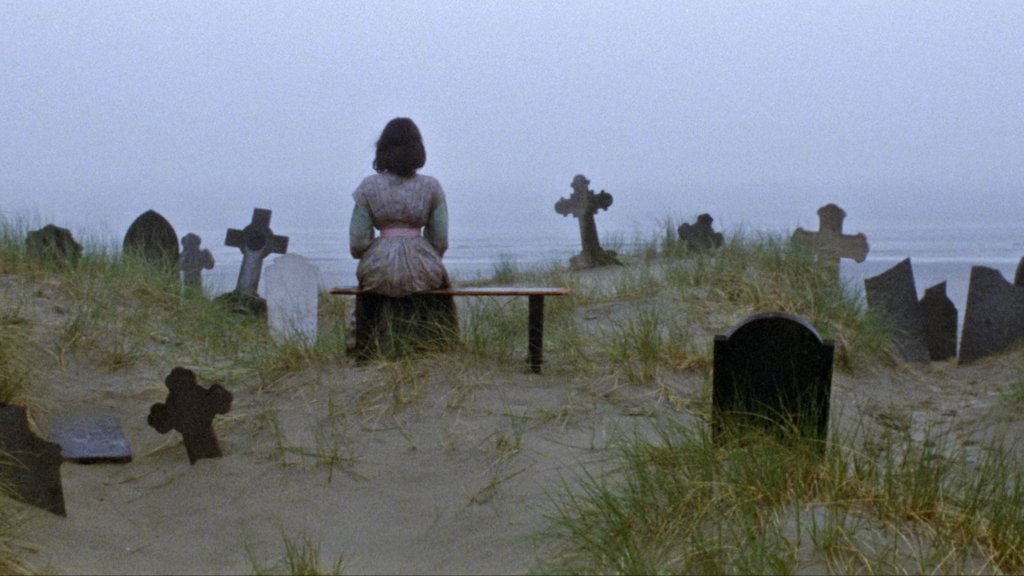
Exciting weeks ahead for Richmond movie fans as we have a full slate of upcoming Hard Light programming in addition to this week’s Virginia Film Festival which some of us will be attending in Charlottesville. So today’s newsletter will provide previews and additional context to our screenings of Babylon, Nosferatu the Vampyre, and an extended exploration of Pedro Costa and Horse Money, but we’ll have some additional newsletters tied to NYFF releases and VAFF that will come out over the next week.
- Babylon (1980) dir. Franco Rosso – Kyle M-B
- Nosferatu the Vampyre (1979) dir. Werner Herzog – Warner West
- The Cinema of Pedro Costa, Cape Verde, and the Carnation Revolution – Syd
- What’s Up Next?
Babylon (1980) dir. Franco Rosso – Kyle M-B

Originally released and subsequently buried in 1980, Franco Rosso’s Babylon stands as a landmark film in the progression of Black Caribbean community on screen. Following the exploits of Blue, a young Jamaican man portrayed brilliantly by musician and actor Brinsley Forde, Babylon takes us into a world of young men trying to find their way in a world that, while their own, wants no part of them.
It’s a tale entirely too familiar for black communities: often forced into circumstances beyond their control, we have to see black characters grapple with a word that has done them a disservice. The film does a brilliant job of showcasing the differing stages of coping that come with trying to maintain your sense of self in a hostile environment. The culture and environments are completely lived in. The film is dedicated to residing within the lives of its characters, using Jamaican Patois for a large portion of its script. Director Franco Rosso and screenwriter Martin Stellman would write these sequences before bringing in Brinsley Ford to make sure the use of the language flowed and was correct.
The film will be the first in our Black Atlantic Series in partnership with the ICA at VCU. Please join us at 7PM on Wednesday, October 22nd for this free screening! More details here.
Nosferatu the Vampyre (1979) dir. Werner Herzog – Warner West
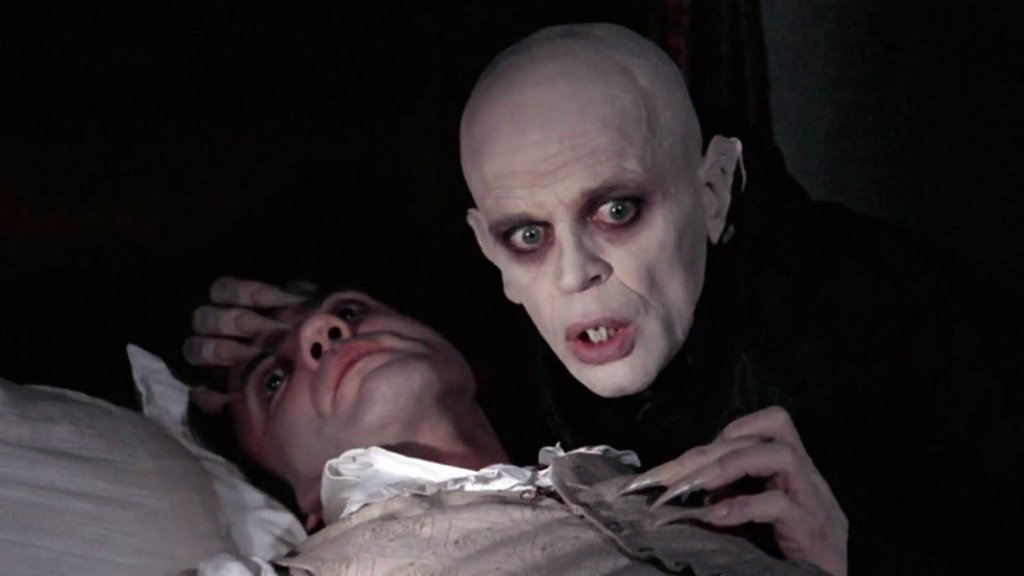
You’ve likely heard the story before: man goes to Transylvania, meets a vampiric count, and brings him back to his city where he ravages his friends and family with plague. Whether in one of the multiple Dracula adaptations over the years or in one of the, slightly different but effectively the same, Nosferatu adaptations put to film, this story has entertained moviegoers since the dawn of cinema.
So why watch this 1979 Herzog adaptation if you’ve already seen the 1920s silent version by Murnau or last year’s adaptation from Robert Eggers? Well first of all, I’m a little biased, but this one is easily the best in my opinion. The original by Murnau does indeed rock, but there are copyright and production issues tied to the film which leads to confusion around different versions. Eggers’ has some cool visuals, but it makes the Count look a touch too much like Doctor Eggman from Sonic the Hedgehog, trading ambience for “authenticity”. Here in Herzog’s version, you still get the sick visuals, production design, a rocking score (the usage of Das Rheingold in this film gives me chills), and my favorite version of the vampire by Klaus Kinski. I’m not even sure if Kinski is acting in some of these scenes as he dominates the screen, making you cringe and shudder. Finally, Isabelle Adjani as Lucy is the best version of the heroine, keeping her dreamy sexuality without trading agency or becoming a pawn.
Look, it’s not often you get the intersection of populist horror and our arthouse sensibilities, but this film genuinely blends the two sensibilities of grindhouse and arthouse into one stunning picture. So join us at Jepson Hall Room 118 at the University of Richmond at 7PM on October 30th for a spooky and fun time. More details here. I’ll see you there!
The Cinema of Pedro Costa, Cape Verde, and the Carnation Revolution – Syd

November 2nd will mark Hard Light’s third Slow Sunday, and our first foray into Pedro Costa’s celebrated filmography with his 2014 film Horse Money. While the film ultimately builds its own self-contained world in which it speaks for itself, going in with some knowledge around Costa’s filmmaking practice, as well as some of the historical events it references, can offer even more depth to an already beautifully-layered and multifaceted watch.
Costa’s artistic trajectory has been anything but conventional, though he got his start with a standard film school education. In 1993, having acquired funding for a sophomore feature, Costa travelled to the island of Cape Verde to film Casa de Lava. Originally, Costa intended to remake Jacques Tourneur’s I Walked with a Zombie (1943). Instead, he found himself falling in love with the island he was filming on and the people there. They found their way into the film in what became a documentary-fiction hybrid, the first step down a rare path of horizontal collaboration Costa would wind his way ever deeper into.
When he finished shooting on Cape Verde, many of the villagers and residents he was working with gave him letters and gifts to deliver to their relatives who had immigrated to Fontainhas, a massive slum outside Lisbon. He was immediately and enthusiastically welcomed into the neighborhood due to the messages he brought and the familiar creole he spoke, and he again found himself in love with the music, faces, flavors, and stories of the community there, too. He felt he had found the home and heart of his filmmaking practice.
He took his next film, Ossos (1997), to Fontainhas. The production was conventional: a film crew of 30 or so, and a whole lot of traditional, expensive filmmaking gear. His cast consisted of some professional actors as well as some residents of the area they were shooting. He recounts this approach as ill-conceived; the bright lights and large cranes disrupted and disrespected the rhythms and reality of the neighborhood. They did not fit, both literally and rhythmically, and he remembers there being no truth or magic to the film.
Vanda, a woman living in the neighborhood and acting in the film, recognized this and constantly challenged Costa to create a film without cheating in the ways she saw Ossos cheat – by having assistants disappear problems on set, by having a set that could be dressed and manipulated in the first place. She invited him to film her sister and herself, in their house, by himself.
The film that emerged was the monumental In Vanda’s Room (2000), a five hour DV document of exactly that: them, and others, sitting, talking, doing drugs, and not much else, as Fontainhas, slated for demolition, began to be leveled. It was his first film in which those in front of the camera guided and constructed the film just as much as the man behind it.
Costa met Ventura in the course of filming In Vanda’s Room. He rode the bus into Fontainhas every day at 8:00AM, and each time he arrived, he encountered Ventura. They exchanged good-mornings, and then eventually longer conversations about the film. As their friendship grew, Costa began to recognize Ventura, one of the first residents and builders of Fontainhas, as a symbol of the past, a keeper of collective memory. He also saw in his wild visions and strangeness a symbol of the sickness and madness that emerged from the legacies of colonialism, racism, and poverty common to so many Cape Verdean immigrants.
Cape Verde’s history is inextricably tangled with Portugal’s history of colonialism and its participation in the Atlantic slave trade. The islands were uninhabited by humans until Portuguese discovery in 1456. Afterwards, with the labor of enslaved West Africans, they were established as sugar cane and cotton plantations. Conditions on the islands were stark; famines, droughts, volcanic eruptions, cruel labor practices, and minimal Portuguese support or intervention took hundreds of thousands of lives from the 16th through 20th centuries. Specifically, from 1943 to 1973, when the total population of the country was below 500,000 persons, over 43,000 people died from starvation.
When the slave trade ended in the 19th century, sharecropping and forced emigration to Portugal’s other African colonies, often under the pretense of “rescue” during famine, replaced it. Additionally, many Cape Verdeans were forced to emigrate to Portugal to build Lisbon’s infrastructure. Others followed in the late 60s to take construction jobs, and found themselves largely being exploited and often cheated out of pay.
Ventura was one such immigrant and worker. Costa saw Ventura’s history, presence, and whole being as urgent to archive and amplify. With Colossal Youth (2006) and Horse Money (2014), Costa not only does that, but inverts the traditional power structure of film production further still: Ventura primarily steers the films. There was no script on these shoots. Instead, Ventura recalls jumbled, displaced chronologies, wandering the landscape and searching for times long past but still present to him. His dialogue is his memories and his reality.
Colossal Youth deals with the remnants of Fontainhas and the stark future its former inhabitants face inside the sterile white houses the government relocated them to. Ventura searches for his family in the remains. Horse Money is estranged from Fontainhas even further; it is pervaded by nameless institutes resembling a hospital or jail. The memories the film exorcise focus on a particularly painful moment of Ventura’s life: Portugal’s 1974 Carnation Revolution.
From 1933 to 1974, Portugal was an authoritarian state known as the Estado Novo. Dictator Antonio de Oliveira Salazar, an admirer of Mussolini, designed his policies to espouse conservatism, stifle free speech, and suppress class struggle. One of his most notably cruel and unpopular dictates was the preservation of Portuguese colonies in Africa long after other European nations relinquished their colonies in the 1950s and 60s. This erupted in 1961 as the 13 year long Portuguese Colonial War, as militant independence movements formed in Angola, Guinea-Bissau, and Mozambique. On March 11th, 1974, the war, the colonies, and the authoritarian regime were brought to an end with a military leftist coup organized by the Armed Forces Movement (MFA). The coup resulted in only six deaths, and was massively popularly supported. People took to the streets and celebrated, offering soldiers carnations and sticking them in the muzzles of their guns.
One of those people was the teenaged Pedro Costa who remembers it as one of the most remarkable times of his life, filled with the excitement of discovering politics, literature, music, and girls. In the same place, at the same time, was Ventura, terrified and hiding, alongside other immigrants, who did not know what the revolution would bring, and only knew what they were losing in it, and that it was by the Portuguese, for the Portuguese. Costa, upon learning this, began looking through archival photos and records of the revolution, and reported finding no instances of inclusion of any African immigrants. Costa described this as how the revolution failed. Ventura described it as inducing a prison in his mind, and a long sleep.
Horse Money is the attempt to describe and maybe escape the impossible complexity of that prison and sleep, by remembering it and forgetting it simultaneously and for the last time. As Costa puts it, “It’s a dangerous enterprise to put the fate of a community, its collective memory, into the trembling hands of a madman. At the same time, cinema seems to have been invented to do exactly this and to tell such tales.”
We hope you join us for this hauntingly beautiful tale. More details here.
What’s Up Next?
October 22nd: Babylon at 7PM at the ICA at VCU.
October 30th: Nosferatu the Vampyre at 7PM at the University of Richmond, Jepson 118.
November 2nd: Horse Money at 2PM at Richmond Public Library, Main Branch.
 Hard Light Cinema