Welcome back to the Hard Light Newsletter! We’re fresh off of a Friday night screening of Hale County This Morning, This Evening at Afterglow where we had a nice intimate night of cinema and wine. Now, just a few days later, we’re already looking forward to our next screening of Claire Denis’s 35 Shots of Rum at Studio Two Three this upcoming Sunday night, May 4th, at 7:30 (doors at 7). It’s a movie by a master that deserves to be seen big, so we’re making it a free showing with donations welcome. You can find more details or RSVP here.
Our newsletter begins with an extended preview of 35 Shots of Rum, starting with Lewis’s introduction to the film and Claire Denis, before moving to a follow-up essay on the work of adaptation when it comes to creating films based on previous movies, followed by an exciting conversation that Kyle M-B had with Alphonse Pierre of Pitchfork primarily about the Western genre, and ending with a “What We’re Into” for the team.
- 35 Shots of Rum (2008) dir. Claire Denis – Lewis Peterson
- What Makes a Remake? – Lewis Peterson
- A Conversation About Westerns with Alphonse Pierre of Pitchfork – Kyle M-B
- What We’re Into: April 28th Edition
- What’s Up Next?
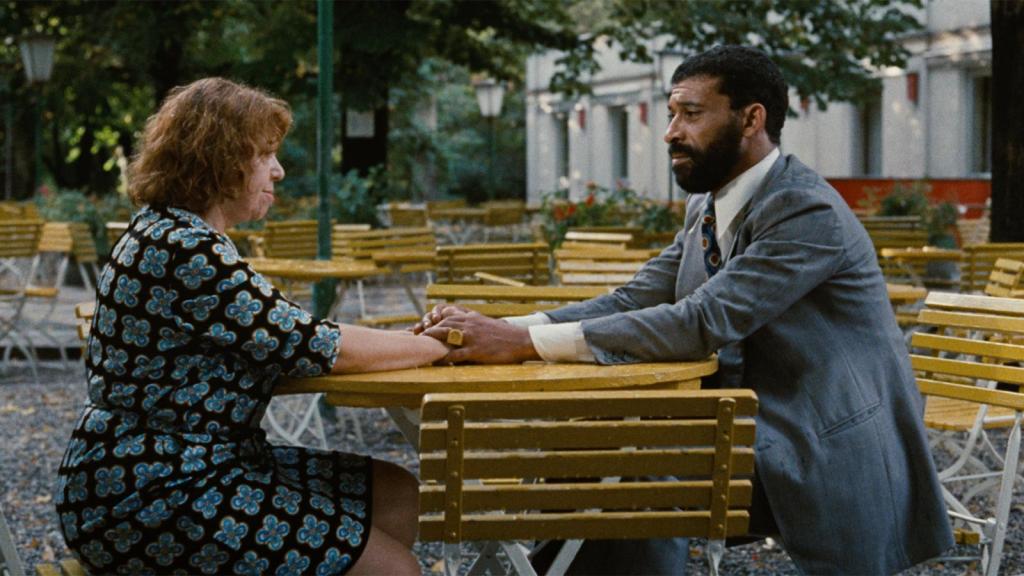
35 Shots of Rum (2008) dir. Claire Denis – Lewis Peterson

Claire Denis was well-established upon the 2008 release of her film 35 Shots of Rum—she had wow’ed audiences worldwide with Beau Travail, her treatise on toxic masculinity in a French Colonial setting, as well as shocked and offended those very same audiences with Trouble Every Day, her extremist vampire film starring Beatrice Dalle and enfant terrible Vincent Gallo. Her films tend to emphasize the body, alienation in a physical and emotional sense, obsession as a form of desire (and vice versa), and French colonialism and its long-lasting impact on French and West African societies. 35 Shots of Rum is a bit unique compared to her other films, as there is significantly less cynicism and no violence. In this way, it’s kind of the perfect primer for those who aren’t familiar with her work, and it’s also the perfect surprise if you know some of her others films and are seeing this for the first time.
Denis, who grew up in various West African countries (Cameroon, Burkina Faso, Benin, and Senegal to name a few) due to her father’s employment with the French Civil Service, has consistently examined the relations between France and its former West African colonies. Films like White Material, Chocolat, No Fear No Die, and Beau Travail all either take place in West African nations, or are about West African immigrants trying to get by in France. 35 Shots of Rum is another film exploring this theme. Inspired by Yasujiro Ozu’s masterpiece Late Spring, Denis’s film also follows the story of a father (frequent Denis collaborator, Alex Descas) and daughter (the elegant Mati Diop) who are bonded so deeply from sharing a life and routine together that helps fill the void left by the death of her mother, and his wife. Ozu’s film was placed in the suburbs outside of Tokyo, while Denis’s film is set in the banlieues (suburbs) of Paris. Both films feature a father and daughter relationship, the threat of increasingly-modern times, the need for a daughter to make a life for herself by finding love of her own, trains, and excessive amounts of alcohol. This is not so much a remake as it is a retelling, lifting visual as well as thematic motifs from Late Spring, but with enough differences to distinguish it as its own film.
Something that makes Claire Denis’s films so endlessly rewarding is her intertextual approach to storytelling. If you’re able to pick-up on the nods to other artists, films, writers, and musicians, you can start to see the creative legacies that Denis is keyed into and start seeing these films as not only an exploration of her worldview but truly films examining the human condition in our modern world. 35 Shots of Rum is absolutely one of these films;there’s the Late Spring/Ozu inspiration driving the film, but there’s also some nods to the legacy of actors in Denis’s own films. Alex Descas, who plays the father Lionel, has made 11 films with Denis to date, and often functions as a self insert/extension of Denis’s worldview. Gregoire Colin, who himself has been in 6 Denis films, reprises his role as Denis’s go-to heartthrob and object of desire. There is also the casting of Mati Diop, a filmmaker in her own right and the niece of Djibril Diop Mambety, a legendary Senegalese filmmaker responsible for masterpieces like Touki Bouki and Hyenas. So it’s not only a film about acknowledging that time is passing and a father needing to let his daughter leave the nest and start her own life, but it’s also a film from an older filmmaker’s perspective seeing the new generation of filmmakers ready to start telling their own stories. The film sees another young woman with a transnational identity (Diop grew up bouncing between Senegal and France, similar to Denis) seek to tell stories about her experience through cinema. In this regard, I find 35 Shots of Rum to be profoundly moving as a family drama as well as a treatise on 21st-century filmmaking. It’s worth noting that Mati Diop has gone on to make some of the most well regarded films of the last 10 years, with both Atlantics and Dahomey, so this passing of the torch clearly worked. And this referential casting acknowledges that Denis has a troupe of actors, just like Ozu did, so to apply her troupe to an Ozu-esque story is the only logical conclusion.
I’m doing my best not to spoil too much, because it’s a film that is a joy to watch unfold. I find having this background information can help take this from a well-made family drama from a seasoned director to a different level entirely. With this film, as with so many from Denis, we see a filmmaker trying to engage with a rich history of international humanist cinema, and in my opinion, she succeeded! The images shot by cinematographer Agnes Godard and the score by Tindersticks are going to be highlighted so well in a space like Studio Two Three. It’s sure to be a beautiful evening: one you won’t soon forget.
RSVP here and join us at Studio Two Three on May 4th at 7:30 (doors at 7) for this beautiful film.
What Makes a Remake? – Lewis Peterson
One of the most common complaints about the current state of film is “too many remakes, reboots, and sequels.” It’s a complaint I often have myself. When you see the live action remake of the animated How To Train Your Dragon is being released, it’s hard to have any respect for a remake. But the notion of taking inspiration and using an older film as a basis for a new work is something that’s been well done in the past, just look at John Carpenter’s The Thing, Martin Scorsese’s Cape Fear, and David Cronenberg’s The Fly! Sometimes a remake can really hit the spot!
But what about movies where it isn’t a one-to-one remake? They are what I like to call a retelling-and next week’s film 35 Shots of Rum is one of them. A retelling is, in my view, a film that clearly has a point of reference and isn’t hiding it. While Hollywood as we know it loves a remake and a reboot, I’ve noticed it’s less interested in these retellings. Some examples of the films that are retellings can be seen in Schrader’s First Reformed (clear riff on Winter Light and Diary of a Country Priest), Assayas’s Clouds of Sils Maria (taking from both Persona and The Bitter Tears of Petra von Kant) Scorsese’s The Departed (inspired by the Hong Kong hit Infernal Affairs) Fassbinder’s Ali: Fear Eats The Soul (inspired by All That Heaven Allows) which in turn inspired another retelling with Todd Haynes’s Far From Heaven. Another master of the retelling is Pedro Almodovar, whose All About My Mother weaves together elements of All About Eve, Opening Night, and Fassbinder’s Lola. His film The Skin I Live In also takes a great deal from the French horror classic Eyes Without a Face.
In all of these films, you’ll be able to enjoy them as their own story, but if you’ve “done the reading” as I like to say, you’ll find each of these films to be infinitely more rewarding as a commentary on the ever changing story of film. It isn’t just in visual references, but there is also often a comment on the original film and its themes to be found in this retelling. What is it about this older film that a filmmaker can find inspiring and worth examining in a new modern lens? By asking this question, we can often find ourselves thinking more about the overall story of film as an art-form. That is when I get tremendously excited as a viewer and find myself thinking about a film long after it has ended.
With Claire Denis, who has made several films inspired by other texts or movies, there’s a fun scavenger hunt for her influences to be had. In the case of 35 Shots of Rum, there is so much in the staging of shots and the set design showing the strong influence of Ozu. There’s a brief moment where Alex Descas as Lionel chooses to wear his bathrobe in a similar way that an Ozu character would wear a Yukata at home. Also, the interiors of Lionel and Josephine’s home is shot in a similar manner to Ozu’s style-we see geometric lines of walls and doorways create a great depth of field of frames within frames-a common Ozu maneuver. There’s the family dynamics affected by the passage of time-a constant Ozu theme that is not exclusive to Late Spring. While they don’t go so far as to include the Ozu Pillow Shot, there is a manner of approaching Ozu’s typical motifs that Denis and cinematographer Agnes Godard incorporate into the film: rice cookers, train tracks, road signs, windows, bars, empty drinking glasses, and intimate apartment buildings all feature prominently.
So, what’s the point? What does knowing the influence of Late Spring add to 35 Shots of Rum?
It’s obviously something that each viewer will react to differently, but for me, it is a testament to the timelessness of Ozu’s storytelling and obsessions. The Ozu setup works just as well in 21st century West African immigrant communities outside of Paris as it did in the late 1930’s suburbs of Tokyo. Humanism is something that will never truly go out of style, and perhaps Denis is suggesting we need this humanist approach now more than ever.
See for yourself on 5/4 at Studio Two Three! I’ll be introducing the film, and I’d love to talk with anyone who loves Late Spring about the connection between the films afterwards.
A Conversation About Westerns with Alphonse Pierre of Pitchfork – Kyle M-B

As a disclaimer, this conversation was an informal conversation between friends rather than a formal interview so the formatting has been made to reflect that tone.
Kyle M-B: I appreciate you taking the time to do this.
Alphonse Pierre: Yeah of course. Thank you for asking me. It sounded cool.
KMB: I mean, you follow me on Twitter. I just talk about these things way too much, and my homie (Ross, I love you) is always like “stop talking to me about this shit and start a blog or something” so I’ve been trying to focus it into this. But you came to mind because anytime I check Letterboxd about a Western, for some reason, you’re there.
AP: *laughs under his breath*
KMB: And it’ll be shit that maybe 500 people have reviewed or something like that. Then I remember listening to your Reel Notes episode (A Rap and Film Podcast from the homie Dylan Green aka CineMasai) and having talked about how you get movies from the New York Public Library. So you have a much wider knowledge base for older films that I feel like a lot of people wouldn’t know. Especially given your access to stuff at the library.
AP: The library in New York has so much just sitting there. There’s this app on the computer if I can’t find something, or if I have found something but it’s really bad quality, I can go on there and the most random shit will just be there. Like some noir from 1946, that’s not on streaming. Or like TCM played it once and I missed it. So the library may have a copy and of course nobody has checked it out and you get it in two days. It’s crazy.
KMB: You even be using TCM to watch these???
AP: Yeah, I got the TCM app and TCM has like 20 movies they play that day and most of these movies end up on the app but only for a very short amount of time. Like maybe two weeks. So it’s really quick-moving.
KMB: That’s crazy and makes me want to ask a bunch of other questions outside of what I wanted to bring you here to talk about. So let’s try to get to these first and then maybe if we have time, we’ll circle back.
I guess the first question is really… Why Westerns? Westerns were so prominent so long ago that I feel like people forget ow many there are, or how important they are to the development of American cinema. So it’s cool to see someone who seems to be taking their time to explore what that realm of films has to offer.
AP: I mean I didn’t grow up interested in Westerns or anything like that. I would sit around with my grandfather and like a lot of older black folk and he’d just be watching westerns all the time. It would mostly be like whatever was on AMC before it became like “the Walking Dead Channel”. Or they’d be on TCM or whatever other old movie channels there were. He would be watching stuff from Clint Eastwood, John Wayne: the really big stuff. It always looked kinda boring and somewhat cheap to me. Like oh, this is clearly on a set or how they spoke felt too melodramatic to me. So it wasn’t until later that I watched The Good, The Bad, And The Ugly for myself that I started to get interested in them. Even though the Sergio Leone westerns aren’t really the ones that I’m interested in. I’m more interested in the westerns that came before the era of the spaghetti western. Stuff from the 40s and the 50s, the real super-American ones, these kind of macho-masculine westerns. I also really like how a Western can also really be any genre and that’s something I didn’t realize as a kid. Like, you can have your comedy, you can have your heist movie, you can have a melodrama. You can have a Jimmy Stewart and Anthony Mann psychological drama. They can just be a hangout movie or even the revisionist ones that completely challenge the form of the genre. So once I realized how big the western could be it was when I became interested.
KMB: Was there a point that you can remember where you were like “I need to look for more of these?” I mean after you found the Leone movies.
AP: A big one for me was seeing Nicholas Ray’s Johnny Guitar (1954)
KMB: Crazy movie. Absolutely insane.
AP: It’s a crazy movie, and it’s the one that opened up to me the breadth of a Western. One, it’s led by Joan Crawford, and you often think of Westerns as these male-led movies, but then seeing a movie break that form and Joan Crawford is just way tougher and way cooler than everyone in the movie. Also, the fact that it was made by Nicholas Ray, who is known way more for melodramas like Rebel Without a Cause (1955) or On Dangerous Ground (1951). I love movies with over-the-top emotions, whether it be a Douglas Sirk melodrama or even a Hong Kong action film. The emotions can be so over the top. It’s theater and Johnny Guitar is like that. Nicholas Ray has this other kind of Western movie, or like a rodeo movie called The Lusty Men (1952), and it’s also like that. Everyone is crying. It’s these men pushing themselves to the brink of death for no reason or for the dumbest of reasons. I’ve always found that to be extremely real, but also hilarious and is part of what made me want to explore further and dig into the crevices of the style.
KMB: I think you bring up a lot of interesting things that we can branch off of when it comes to the Western. I don’t know if you would agree but the Western to me is the first time that American cinema established its own foothold in the way the world thinks about American cinema. Like if we say that noir is born in Germany but is refined in the U.S., then the Western is born in the U.S., refined in the U.S., and then really only a select amount of people truly got to that level of classic American iconography and style. The style and technique became so refined that basically any genre can exist within it and be successful. So there’s this whole canvas of what is possible within a Western, but it’s not being filled anymore because people don’t make them. It’s a uniquely American form for creating cinema.
AP: It definitely was, that’s also what kind of drove me to it. It’s a glimpse into a once-popular style of movie-making that wasn’t just popular but had its own B movies. Like of course you had the John Wayne and Gregory Peck movies but then you have the Randolph Scott and Budd Boetticher movies. Movies like Ride Lonesome (1959), The Tall T (1957), and 7 Men from Now (1956). I got one of Budd Boetticher’s box sets and it had like seven westerns on it all starting Randolph Scott. They’re all under 80 minutes and are these tight complete stories where Scott is kind of the same sheriff or good ol’ boy character in all of them. They all have these different touches to them. One may be about a murder, there’s one that’s about like communicating with Native Americans. I think seeing the genre so scaled back helped me discover more of what it could be. It was all interesting and new for me.
KMB: It feels like the only reference points people have for a Western are John Wayne, John Ford, and like later Clint Eastwood. Which is interesting cause they make such a particular type of Western.
AP: For sure.
KMB: I guess the other name would maybe be Anthony Mann, but that’s also because he has Jimmy Stewart, who is arguably one of the most famous American actors to ever live.
AP: Even then I don’t think the Anthony Mann movies are known by people who aren’t really into movies. If you ask someone their favorite Western actor they’re gonna say someone like Clint Eastwood or John Wayne.
KMB: What is it about Mann that puts him over the top for you? Does have as many Westerns as John Ford does? Cause that’s all that I see that this motherfucka has made.
AP: He has a lot of Westerns but he also has a lot of other stuff as well. He’s got a lot of noirs in the 40s, and some mystery movies. He has this extremely cool movie called Reign of Terror (1949) that’s like a French Revolution movie that came out right before he really started making westerns. I think I just liked how dark his westerns were. So much of the American idealism John Ford stuff I haven’t jived with as much. I always liked the ones that seemed a little twisted, especially ones that played with my expectations because of how I was familiar with Jimmy Stewart mostly at first because of Hitchcock movies, and he’d be playing some kind of man in peril.
KMB: Or like obsessed with a woman.
AP: Yeah, and he’s not always the hero or the villain. He feels like the archetype of what would be like Tony Soprano or Walter White. These guys you kinda root for but are also terrible people who are put in the center of the movie. The Mann Westerns I think showed me just how dark they can be.
KMB: They were definitely at a different level when I started to experience his work. Just even in Winchester 73, it stands in such contrast to the rest of the films from that period. Watching a Ford Western feels like watching the big tent-pole summer movie. Like if there’s a John Ford movie out that summer that’s the one that everyone is going to see. Makes me wonder why you think this particular style of Western was so appealing to people.
AP: I think John Ford is just another person that just makes so many different kinds of movies that my saying that his films are filled with “American Idealism” could be kind of flattening. Just because he made so many movies, and I’m still working my way through them. It’s like an overwhelming amount of movies.
KMB: With some of these old Hollywood dudes, it’s fucking impossible.
AP: They was just churning shit out, but like he has his complicated ones. Like The Searchers inspired everything from Taxi Driver to Paul Schrader’s like whole vibe and then you can tell just how complicated and fucked-up that movie is. I think he was just able to articulate what America is, what it was, and maybe what it might be. I don’t think it always meshes with me, I don’t dig the vibe of it. I mean I love The Man Who Shot Liberty Valance, that shit is like Teflon.
KMB: What a fucking movie. It’s one of those movies where you watch it and just wanna throw it on again, and then you remember it’s like two hours long.
AP: It’s exactly like that but that just shows the type of range Ford had as a filmmaker.
KMB: I think this leads well into John Wayne too because in “Liberty Valance”, Wayne is playing like a parody of himself in these Western movies in so many ways. He’s this hyper-masculine destructive guy, but then the movie also admires him for it in so many ways. It feels like Ford is trying to reconcile with his own choices in his films and the way he depicts Wayne on screen. Of course, you have the foil to that in Jimmy Stewart being the complete opposite. It’s like Hollywood diverging from itself in the same movie. John is the old way and the destructive way, and the new way is Jimmy Stewart and some type of more “gentlemanly” appearance, if you could call it that.
AP: He was definitely in his Scorsese post-Irishman bag. Looking at his career and impact on movies as a whole, that’s definitely when he’s the most interesting. That’s also the most interesting John Wayne too. When he’s like a parody of himself or like against type. Sometimes when you go back and watch Wayne films and he’s the hero it feels like he’s just this old conservative Captain America type figure. So when he’s the villain it’s way cooler. That’s why the Howard Hawks movie Red River with him and Montgomery Cliff goes so hard. John Wayne is basically the villain of that one and is sending all his men to death and understands the John Wayne mythos just as much as Ford does.
KMB: Damn, I still gotta watch that.
AP: Yeah, that’s a banger.
KMB: You mentioned early some of these revisionist Westerns. There’s obviously parts of old Hollywood that don’t age well and show the racism and incompetence-level of how people are represented or how history itself is depicted, so I wanted to see how you felt about how black westerns fit into that because the history is so sorted. I feel like we’re only now starting to scratch the surface of what those stories were and could be. Like really, the first one I saw was The Harder They Fall a couple of years ago. Then Criterion put out Buck and the Preacher last year and I saw that and was blown away. Cause Sidney Poitier and Harry Belafonte go crazy in that movie. Then you start to try and find other ones and it’s really difficult. Movies for so long weren’t taken care of so of course black movies were even less so.
AP: They are there, but they are also super hard to come by. A lot of them are really low-budget. I think my first experience with a black western, even though it’s a parody and the black actor isn’t even really the lead but Blazing Saddles. Just even having a black character in the West who isn’t a maid or a butler was cool to see when I was really young. A lot of my older movie-watching comes from middle school. I had this class that was for photojournalism and it was supposed to be a class about learning cameras but the teacher was just into movies so we just watched movies all the time. So he basically just took us through the history of movies. I took this class for three years from 6th to 8th grade. We’d watch silent movies from Buster Keaton, Charlie Chaplin, and Harold Lloyd. We would watch so many Hitchcock movies… we would watch a lot of old I Love Lucy episodes.
KMB: So you got an education about the breadth and history of cinema early on.
AP: Yeah definitely but through this teacher’s perspective. He was still a white guy so like there weren’t many movies about black people or women or anything like that. Very much what he thought movies were. It was a lot of Hitchcock, a lot of Marx Brothers, he showed us Young Frankenstein. So that’s what led me to see Blazing Saddles on my own. I remember seeing that in comparison to the westerns that my grandfather was watching and it stood in such contrast to those. So by the time I watched Buck and the Preacher or Thomasine & Bushrod by Gordon Parks Jr., I knew these were movies that were aware of the history of the western and how black people were squeezed out of them, and if they were in them they were depicted as trash so they’re reclaiming them in a way. Even the Mario Van Peebles movie Posse from the early 90s is a black revisionist-western with like him and Debo from Friday in it. They’re all interesting takes on the genre with so much history and doing it from their perspective.
KMB: We have this rich history of the Western and all these ideas can be used within the context of what the Western is, so I was wondering what you think modern cinema takes from the Western and what you think modern cinema can take more from the Western.
AP: I mean the idea of the modern framework of the anti-hero can be found in the Western. Like obviously the archetype can be found before the Western but the modern framework of how these characters operate comes from the Western. I watch so many movies now, especially in action, where I think “Oh this could have just been a Western”. Either with how a stand-off happens or how the love interest subplot develops. It’s kind of in everything even if they’re not really here anymore. I know there’s modern ones like Tombstone or Unforgiven. Or like the S. Craig Zahler movies. But it is in everything a little bit.
KMB: Obviously you write about rap for a living and rap is of course something that is also filled with so much melodramatic bravado. Do you ever see the parallels between the two or think about the two together at all?
AP: I think about it all the time, like I’ll see a great western like William Wyler’s The Big Country or something like that, and all I can think is that the shit was mad hip-hop. Like you were saying this masculine bravado and the ridiculousness of it, and everything they do is turned up to 100. Everything they do, the way they talk, I’ll be thinking the shit sounds like a Raekwon verse.
KMB: There’s definitely a cadence and a rhythm to it all.
AP: There’s definitely a bounce that comes with the great ones or the films I really like. Even their complicated relationships with women, from what the characters themselves are often thinking about. Or how so many of these movies are about trying to get rich quick, or they’re battling cops or robbers. A lot of the time too the sheriff in the movie is the fuckin’ dickhead ya know. Like that doesn’t always happen. Like in noir the detective is the one we follow and is the one who has to put the pieces together. But in a western they might be in battle with the sheriff, or they’re the one who’s haggling them or stopping them from their goal. That’s the stuff that makes me think stuff is mad hip-hop.
KMB: What is it about Hip-hop and Westerns that draws you so much? Why do you think Westerns and Hip-hop are such good mediums to address some of these thematic or interpersonal topics?
AP: I think it comes down to how open they are. Just like how a Western can be anything, a rap song can be anything. They come from similar sources. Like I said in the beginning, my grandfather watched and still watches a lot of westerns and being around that you also just see so many rap lines that reference Clint Eastwood and John Wayne lines there are. You see how influenced blacksploitation is by Westerns, how influenced Spike Lee is by Westerns, so it’s just so ingrained in us. They’re both styles that have this macho energy to them and so much of the greatest work in both of them are ones that double-down on that or find a way to completely subvert them.
KMB: I think they both serve as a way to be direct in what they’re trying to say or do. They’re both able to reflect on things so clearly that maybe other genres can.
AP: A lot of westerns too just comes down to fly shit. They want some money, they want some girls, they want some booze, they want a nice hat or some boots or like a shiny belt buckle or a horse. So it’s also a lot of rags-to-riches stories that they both share.
KMB: For sure. I wanna thank you so much for talking to me about this. I appreciate it.
AP: Of course! I don’t get to talk about this stuff often so it was nice. I appreciate it.
Alphonse Pierre’s work can be found here at Pitchfork.
A list of movies mentioned can be found in a Letterboxd list here.
What We’re Into: April 28th Edition
Tommy Jenkins
Tommy has been into:
-Deborah Stratman movies. Highlights for me have been In Order Not to Be Here (2002), a chilling observation of suburban paranoia, and Last Things (2023), a dedication to the natural world has been giving me chills just thinking about it since New Habit screened it at the library last week.
-I also continue to be obsessed with the cinema of Lav Diaz and spend any free day I have watching his movies. Most recently I watched From What Is Before (2014).
Kyle M-B
Kyle has been into:
-“HeadBanger” (Supreme Skate Video). Director William Strobeck and Supreme are no strangers to crafting immaculately paced and scored skate videos and this video is no different. The skating is solid of course but for me its all the moments in between this time that make it even better. It’s truly the bond between everyone here that makes the video feel so special.
-Papaholic, Vol.1 (Papo2oo4 & Subjxct 5). Anyone telling you that New York Hip-Hop is dead simply isn’t paying attention. Papo2oo4 has been one of the city’s most consistent acts and with his latest project produced by Subjxct 5, the duo provide maybe their greatest collaboration yet. With all of the gritty and lush swag raps you can handle. Fav Tracks: Chopper City, Sosua Beach, Triple Black
-Deadly Prey Gallery at Pamplemousse. Got a chance to see some of the iconic posters of Ghanaian artist collective Deadly Prey. The gallery had prints for sale and seeing the originals on such large canvas really made all of the color and expressiveness of their work standout. I even got to take home two prints, one for La Haine and one for Wild At Heart.
Sylvie Miller
Sylvie has been into:
-Really enjoying meditating on one chapter per week of “The Haunting of Hill House via book club.
-Stirring up the pollen by dancing to lots of Deux, Aurat, Die Puppe, Alice Glass, and Geneva Jacuzzi.
-Having many movie nights with friends watching favorites like Addams Family Values, Possession, and All About Lily Chou-Chou.
-Watching Ken Russell’s The Devils for the first time while enjoying a spread of snacks to celebrate recently turning 27
Lewis Peterson
Lewis has been into:
-Flower arranging (getting loose stems from the grocery store or my friend’s shop at Field and making the house beautiful)
-RaMell Ross interviewed by Barry Jenkins for Nickel Boys at the most recent New York Film Festival (watch here)
-the beginning of farmer’s market season and most importantly ASPARAGUS SEASON
-Claire Denis’s earlier films, like “U.S. Go Home” and No Fear No Die
-making dinner for my friends
-the Olive Major/Jane Dough Baguette popup at Celladora! i had an incredible black pepper strawberry jam baguette w/ some butter and cheese. so simple and so delightful!
-taking walks! it’s prime Walking Season in richmond and i couldnt be happier
Warner West
Warner has been into:
-Still his OKC Thunder who have killed it so far through one week of the playoffs.
-Calpico, an oldie but a goodie. Loving the peach flavor at Tokyo Market before a Byrd movie.
-Tsai Ming-liang; I’ve nearly completed the filmography, but each of the last few rivals my favorites.
-Writing on movies! I started a new Substack here to try and think critically about films in general. If you’ve liked this newsletter project, you’ll probably like my personal writing.
-The humble exercise bike; My copy of NBA2K for the PS5 is messed up, so I’ve replaced my video gaming with working-out to great success.
-Fantasy football dynasty draft research. I’ve never done dynasty before this year but looking up 6th round running backs is a fun way to spend a Saturday night.
Jay Wilson
Jay has been into:
-Nighttime strolls while listening to new record from International Anthem, Uhlmann Johnson Wilkes. RIYL: Joseph Shabason, Phoebe Bridgers’ Punisher, Jaco Pastorius’s “Portrait of Tracy”
-Dreaming of summer while watching Agnes Varda films (Along the Coast, Uncle Yanco, Le Bonheur)
-Eavesdropping at the VMFA lawn
-Casual coworker conversations with my roommate’s cat
Jack Wolfe
Jack has been into:
-PinkPanthress’ new single “Tonight”
-Playing the Marathon closed Alpha with besties
-Rewatching Mad Men again for the [REDACTED] time
-Leaving my balcony door open now that the rain has washed the ridiculous amounts of pollen away
-obsessively checking zillow instead of doomscrolling
-shooting an entire roll of film in one day
-3” inseam shorts
What’s Up Next?
May 4: 35 Shots of Rum at Studio Two Three
May 12: Our next Hard Light newsletter <3
May 25th: Another exciting Hard Light screening! Details TBA.
 Hard Light Cinema