
Hello to all of our readers! Sorry for the brief hiatus as we navigated scheduling some upcoming screenings, but we’re excited to announce that our next movie will be Hale County This Morning, This Evening by RaMell Ross, director of Nickel Boys. The event will be at Afterglow on Friday, April 25th at 8PM (doors at 7:30). It was an easy choice for Hard Light because it continues our Indie Black Cinema series and allows us to keep working with our friends at The Cinema Guild.
This newsletter starts with a preview of Hale County This Morning, This Evening by Kyle M-B, followed by reviews of David Cronenberg’s Crimes of the Future by Deirdre Bouquet as part of Exposure Cinema’s Teknoerotica series and new release Matthew Rankin’s Universal Language by Warner West, before ending with another, back by popular demand, “What We’re Into” segment. Thanks again for subscribing, and, if you like what you’re reading, please share with movie-loving friends in the city and elsewhere.
- Hale County This Morning, This Evening (2018) dir. RaMell Ross – Kyle M-B
- Crimes of the Future (2022) dir. David Cronenberg – Deirdre Bouquet
- Universal Language (2025) dir. Matthew Rankin – Warner West
- What We’re Into: April 14th Edition
- What’s Up Next?
Hale County This Morning, This Evening (2018) dir. RaMell Ross – Kyle M-B

Before he would dazzle film audiences with his innovative first person perspective in his film Nickel Boys, RaMell Ross’s debut feature Hale County This Morning, This Evening takes us into the lives of a community that only those who live there could experience. A swirling and intimate portrait of the people of Hale County, Alabama, the film takes us into their lives, hopes, and dreams. Shedding the light on the humanity within us all, Ross’s camera demonstrates that the reality of black life needs no economic or social context to be understood but how black life simply needs to be shown. The film is not only an examination of how the people in the film see themselves, but also how they are observed and perceived. With the continued dehumanization of black life in our country and on our screens, Hale County This Morning, This Evening shows us that no justification for black life needs to be shown or given, as the only thing that separates this community and this life from another is the circumstances in which they may live. Often times when blackness is shown or depicted on screen, life is framed through tragedy or triumph: within Hale County This Morning, This Evening, life is simply lived, and we get the chance to observe it.
Join us at Afterglow on April 25th at 8PM to watch this transformative film on the big screen in an intimate setting. Buy your tickets here.
Crimes of the Future (2022) dir. David Cronenberg – Deirdre Bouquet
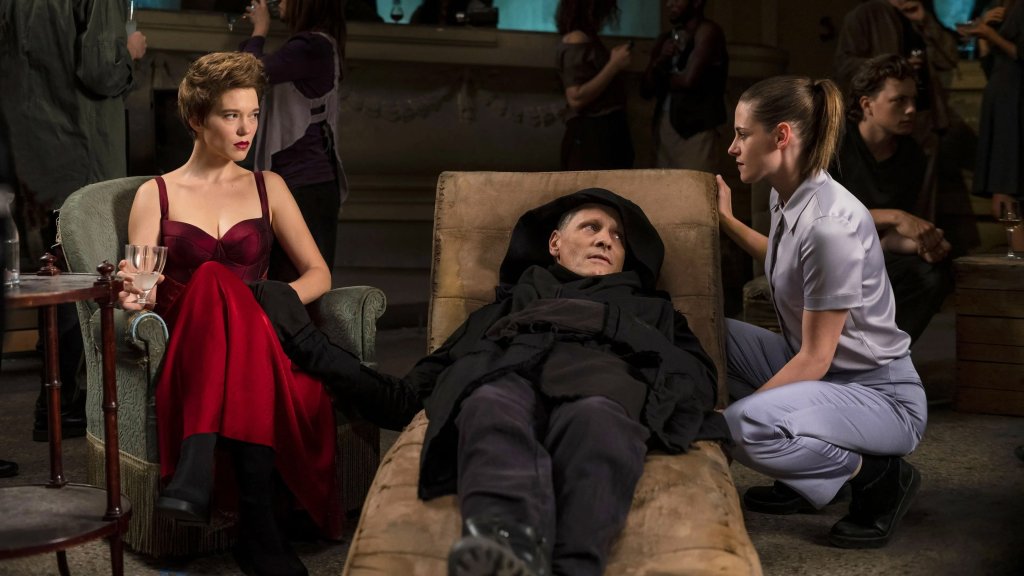
Crimes of the Future is a bit of a mess. Set in a cyberpunk dystopia, we follow Saul (Viggo Mortensen), a man whose body keeps growing neo-organs that are then to be removed by his partner Caprice (Lea Seydoux) in a public, kink-coded bit of performance art. It is fleshy and sexy but also rather vague and dreamlike or, less generously, rambling. The primary conflict surrounds whether these neo-organs are cancers to be regulated and removed or adaptations to be embraced. This on its face is all a bit silly, especially when it flirts with environmental politics. But forget the tangents; this is Cronenberg, so what we actually care about here is bodies bodies bodies. Body horror is a convenient subgenre if you want to layer your movie with the pretense of meaning without saying anything. When you feature horrible fusions of flesh that transcend the boundaries of taste, it’s easy to assume you have something to say. Crimes of the Future actually takes seriously the promise of its genres, with one of the most considered critiques of the ways in which different axes of power dominate and regulate bodies.
Amid all the sexy sexy surgery and skullduggery, we also follow a couple of off-putting bureaucrats tasked with the naming and sorting of neo-organs. They come off as hapless, yet the movie treats them with a distinct wariness. They represent the type of state power that is exercised in a grey room with fluorescent lighting; they use the authority of the state to create names and taxonomies. In other words, they order subjects and thereby order who is subject to what type of state power and in what context. This is the stuff of defining and reinforcing the boundaries of normalcy, of who is more or less human, what operation is medical or cosmetic, surgery or mutilation. The movie demonstrates how they keep neo-organs in jars. An organ in a glass jar is easier to define as inhuman and invasive than one hidden behind the walls of an otherwise-working body. Interestingly, the two bureaucrats both dip their toes across the boundary they enforce in different ways, but this boundary-pushing does not disrupt the power they wield. Kristen Stewart’s character attends these public surgeries with a performative disgust, before excitedly expressing that “surgery is the new sex.” She fetishizes Viggo for his production of these neo-organs while threatening to turn her coworker in for becoming too invested in the subject. In our own context, the political right fetishizes trans bodies as they call them degenerate. This isn’t because they are trans or have secret sympathies; it’s because fetishization is part of the process of denigrating and dehumanizing. Her coworker, meanwhile, develops radical sentiments that contradict his own role – urging Viggo not to remove his neo-organs. Bureaucrats often are driven by passion and sympathy, but bureaucracy, even as it extends state control, has legitimate functions. An asylum officer may be driven by sympathy for asylum seekers and end up getting many through the process faster, even as they perpetuate the legitimacy of that process. In addition, passion can also compel someone to seek power over something – a sort of benevolent paternalism.
As viewers, it seems strange that there is so much concern from various sites of power over adaptations and evolutions, occurring naturally or prompted by surgery, that alter bodily functions. Characters already participate in, and even grow bored of, surgeries and surgical performances that are unthinkable to modern viewers. Yet, the boundaries of what one can do to the body are not abolished here. They are as strictly enforced as today, just with different markers. That shift is somewhat arbitrary of course. Why is it okay to install ears all over your body but enabling your body to digest plastic is aberrant behavior? This requires us to reflect back on our own context – why, for example, is some gender affirming surgery acceptable and even necessary and some is considered mutilation? The answer of course is not the details of the surgery itself but the ways in which it clashes with other norms of the body and its expression. A surgery that removes intersex characteristics so that a body will cohere to the gender given at birth? Necessary. Changing genitals to cohere with felt and expressed gender? Mutilation. While the film focuses on the regulation of transhumanism (the body that adapts to function beyond the normal scope of the human body), the dynamics broadly mimic politics around queerness today.
Through exploring the role of surgery in the cultural sphere (performance, sex play, and visual transformation), the film also illustrates that the body is not regulated from on high, these processes are deeply ingrained in our everyday life, just as the regulators themselves are. These surgical performances are framed by our main characters as radical explorations of human form, but they are also sites for the reinforcement of boundaries – the boundary has some give but at what point do we hit a hard limit? Characters representing institutions of power actively recognize this. At one point, the main characters dissect a body with natural adaptations only to find organs that are apparently mangled and disgusting, the audience who previously applauded or reacted in shocked delight at surgeries on conscious patients, now gasp with horror. To the shock of the main characters, who are ultimately attempting to navigate this dilemma with the ethics of performance artists, they discover someone had modified the organs to generate this response in the onlookers, to create a physical manifestation of disgust that is subconsciously felt about these adaptations- reminiscent of the ways in which right wingers parade gory pictures of trans surgeries to demonstrate some apparent innate perversity. The film meanwhile seems careful to treat all these processes with an unusual amount of gentleness and humanity.
Even as it engages in revealing hypocrisy and also titillating and disturbing the audience with body horror, it does not show the surgeries accepted by this world as purely excessive or disgusting. At one point a character remarks that it is hard to get a surgeon to understand that they don’t always want to look more beautiful – parallelling the role of modern surgery in bringing internal identity and outward expression more in-line. In treating what is strange to most viewers with sympathy, it helps to reveal the arbitrary way the limits of acceptance are defined in the world of the movie and our own.
Crimes of the Future recently screened as part of Exposure Cinema’s Teknoerotica series which has upcoming screenings on Wednesdays. More information here.
Universal Language (2025) dir. Matthew Rankin – Warner West

Universal Language, Matthew Rankin’s sophomore love letter to Canada, is a strange project as it’s steeped in artifice from its opening scene where a school has a huge sign in Farsi that is subtitled as “Robert H. Smith School”. To those familiar with Rankin, this irreality of his Canadian homeland is nothing new. After all, his debut feature, The Twentieth Century, is a mock-biopic aping those of the early-20th century. Rankin even claims his goal was to create a movie where “Canada might just be totally fake”1. To some, this level upon level of precise lies will come off as a poor imitation of Wes Anderson, like fellow Wes-mimickers Gentleman Broncos or A Glimpse Inside the Mind of Charles Swan III. I think that’s the wrong Anders(s)on to cite though, as this movie’s dry awkward social comedy is much more similar to the films of Swedish filmmaker Roy Andersson with a little bit of Abbas Kiarostami mixed into the recipe.
There are homages to Andersson littered throughout with the wide shots showing an enormous scene with a small person walking across it or hectic bar scenes (in this case, Tim Horton’s, naturally) where your eyes scan for points of interest. The most iconic one of these is in an office [shown in the header] where two characters are having a conversation on the far right side of the screen while a mounted picture of a governmental leader, a Canadian flag, and a small cubicle are in view. The conversation proceeds and when the speaker changes, it follows the typical shot/reverse-shot structure but without zooming in on our chatting characters, revealing that the opposite wall has the same portrait and the same flag mirrored on the other side. At first glance, this is nothing more than a dry gag to get a few scattered laughs from the audience, but as the scene proceeds you begin to notice that the reverse-shot has a man in the cubicle, barely in view, sobbing. In this cold world of… Canada, the conversation continues despite the noise of weeping, and the man isn’t allowed privacy even from the camera. This normal tone of awkward frigidity makes the warm scenes that much more meaningful though, and there are indeed warm scenes.
Though Andersson is the largest visual influence, the film has numerous allusions to the films of Abbas Kiarostami that bring levity and warmth to the cold landscape. This Canada meets Kiarostami –Canuck-ostami if you will – is most seen in its plot similarities to Where is the Friend’s House, but the movie also inches close to docufiction at times with the director appearing as a character named Matthew (we can reasonably assume he’s playing himself). While I understand the complaints that Rankin is applying an Orientalism of Iran onto Canada, I think this “filter” is all an homage based in love rather than a mocking or derisive tone. You know: imitation, flattery, etc. Though I wasn’t familiar with Rankin before Universal Language, his ability to seamlessly borrow the style of other notable arthouse auteurs immediately garnered my interest and approval. If you appreciate Andersson or Kiarostami, I suspect you’ll find a familiar voice in Matthew Rankin.
Universal Language is out now for rental on VOD platforms.
What We’re Into: April 14th Edition
Tommy Jenkins
Tommy has been into:
-Jane Remover – Revengeseekerz
-d.silvestre – ESPANTA GRINGO
-Various Dariacore albums such as: berdlycore chapter 1 by xaev, Giratinightcore: Emerald by gingus, Ten Nights’ Dreams by takahiro(FKS)
-Billie Holiday (recently been deep diving into her early recordings with Columbia)
-Collective Reading @ Gothic Baba’s Book Club (we’re reading The Haunting of Hill House by Shirley Jackson)
-In the Swarm: Digital Prospects by Byung-Chul Han
-Satyajit Ray’s Apu Trilogy
Kyle M-B
Kyle has been into:
-Nino Paid: Rapper Nino Paid has exploded in popularity over the last year or so, cementing him as the top of a new wave of artists centered around D.C., Maryland, and Virginia (DMV). With a straightforward and honest approach to his lyrics, Nino quickly separated himself from a generation of artists who often find it difficult to create in their own troubles and insecurities, as too often displaying those emotions can lead to less-than-fruitful careers. Nino however has continued to excel, reveling in his success, gliding across beats with whispery flows and hitting the tightest of pockets. Whether he’s baring his soul on songs like Play this at my funeral, or twisting his words and metaphors like a pretzel on songs like Billy & Mandy with DC2Trill (Another artist having a hell of a 2025), Nino seems ready and able to conquer and beat in front him. His latest Album Love Me As I Am is available now.
–Kim Possible: Sometimes you just need to kick back and enjoy some comfort from your childhood. For me that’s been Kim Possible. Originally airing on the Disney Channel between 2002 and 2007, the series follows the everyday exploits of teenage hero extraordinaire Kim Possible and her best friend/sidekick/eventual boyfriend Ron Stoppable. Despite its simple and, at that point refined, villain of the week structure of children’s television, the show does an absolutely amazing job at developing its characters. Kim with all of her amazing abilities and accomplishments still has faults that keep her from veering into superhero territory. She can be petty and jealous, and she’s consistently entrenched in trying to maintain her social status within her school alongside the rest of her family dynamics. It continues to be an engaging rewatch and at this rate I should be wrapped up with the series again in no time.
–How Directors Dress: How Directors Dress is a book of essays focused on questions surrounding how and why film directors dress the way they do. Just like within a film, clothing can tell us a lot about who a person is or what they are trying to portray. The context of the clothes is just as, if not more important than what the clothes are in the first place. Even more crucial than that, who is wearing them can completely alter both of the previous questions. Unlike Acting or being a musical artist, directors’ work doesn’t necessarily involve their presence, so what they are wearing and how they are seen is almost like a small window into their mind and the attitudes into how they see themselves or their work. It’s a fascinating series of essays that explores the identity of the director and, as someone who directs and has had an obsession with clothing, was an absolutely delightful read.
Lewis Peterson
Lewis has been into:
-horsegirl/phonetics on and on
-films of claire denis
-the news that thomas pynchon will be releasing a new novel
-all the cherry, magnolia, and dogwood blossoms
-john berger’s ways of seeing
-spring cleaning/rearranging my home to keep it fresh
-the painting Primavera, by Sandro Botticelli
-nadia/welcome sweet morning
Warner West
Warner has been into:
-Still loose-leaf teas. Rostov’s Richmond Blend has become a favorite quickly.
-Tarkovsky. Predictable but its just so easy to fall back in love. Expect some wacky weekend where I rewatch them all soon.
-1930s William Powell. The Thin Man and My Man Godfrey in one night has converted me.
-New Palmyra album. Pretty good!
-Stardew Valley in every free non-movie/work moment. Still Y1 but in Winter and have a good cranberry/keg build going.
-My Oklahoma City Thunder, which have given me hope for the first time since high school.
Jay Wilson
Jay has been into:
-running down alleys instead of streets
-ECM album covers
-trudging thru bob dylan’s tarantula
-building my casio watch collection
-perennial song of the summer “slide” by calvin harris ft frank ocean and migos
What’s Up Next?
April 25: Hale County This Morning, This Evening at Afterglow.
April 28: Newsletter w/ preview of Claire Denis’ 35 Shots of Rum and an interview with Alphonse Pierre from Pitchfork.
May 4: 35 Shots of Rum at Studio Two Three.
 Hard Light Cinema