Another Hard Light newsletter coming at you this week after a successful screening of You Burn Me at Afterglow. We sold out the venue, showed a great film (with a killer Maya Deren short to open it), and tried a new interactive feature called a “Live Letterboxd” at the end where your anonymous ratings displayed on screen following the film. The film received high ratings amongst the majority of the crowd, and we received some useful feedback to help us moving forward so a big thank-you to whoever voted or wrote a comment.
Looking ahead, this newsletter will begin with a preview of our next feature, Tropical Malady, with a write-up from Tommy who chose the film as his staff pick. We’ll be showing Tropical Malady at Studio Two Three this Thursday for FREE (although we’ll gladly take donations via Venmo or at our concessions table!). RSVP here.
After that preview, we have a short piece on Slow Cinema by Lewis that will serve as a roadmap and instruction booklet for those who aren’t yet familiar. Then we bring you that promised review of Bong Joon Ho’s newest feature, Mickey 17, by Deirdre. Finally, we’ll end with a segment that we’re calling “What We’re Into” as a way to have short pieces from our members about movies, music, food, and whatever else has brought a smile to our faces over the past few weeks. Think of it as a way to get to know us better and provide some conversation starters for when you see us all at screenings in the future!
- Tropical Malady (2004) dir. Apichatpong Weerasethakul – Tommy Jenkins
- Slow Cinema: A Roadmap – Lewis Peterson
- Mickey 17: A Lukewarm Condemnation – Deirdre Bouquet
- What We’re Into: March 31st Edition
- What’s Up Next?
Tropical Malady (2004) dir. Apichatpong Weerasethakul – Tommy Jenkins
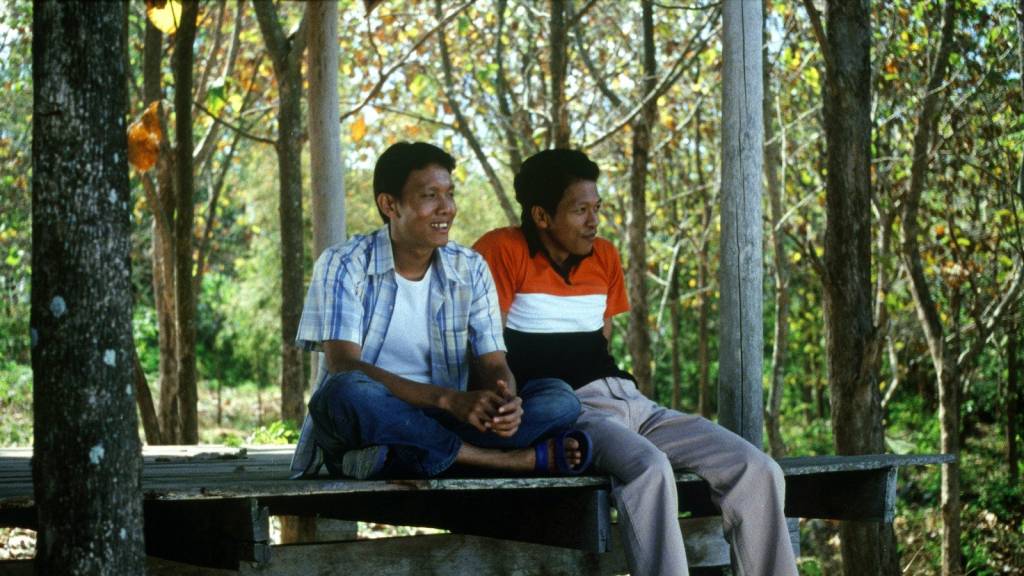
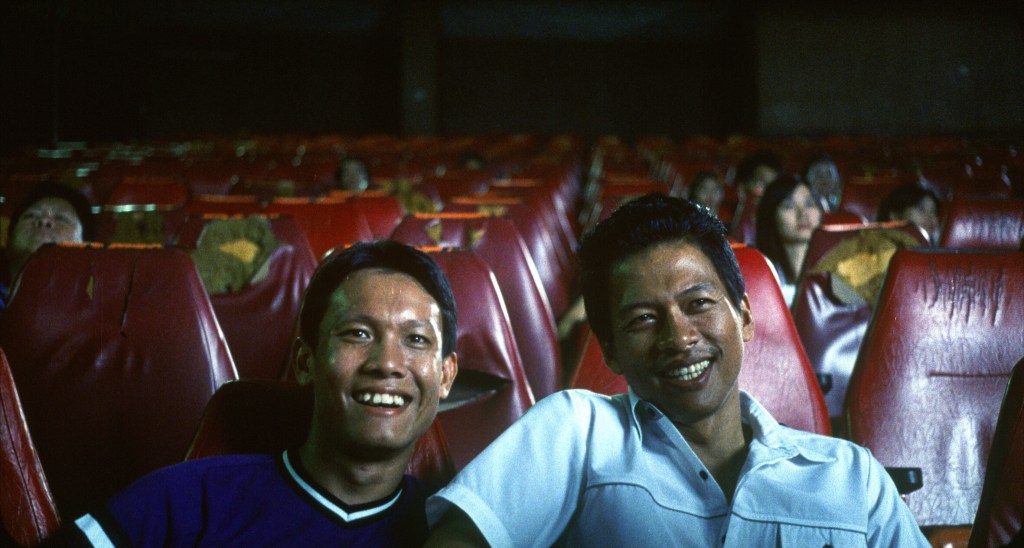
On April 3rd, 2025, at Richmond’s Studio Two Three, Hard Light will be screening my choice for the debut of our Staff Picks series: Thai experimental filmmaker Apichatpong Weerasethakul’s mid-career masterpiece Tropical Malady. The film tells the story of a romance between Keng, a young soldier, and Tong, a rural laborer, whose blissful love affair is interrupted as the lines between myth, reality, humanity, and nature begin to blur. To give an idea of what the film is like, it helps to know that Weerasethakul’s artistic background before getting into film-making was studying deconstructivist architecture. Accordingly, his films often have unconventional structures and experiment with the temporal linearity inherent to the medium by creating languid, still atmospheres that emphasize, rather than compress, the passage of time.
Weerasethakul’s perspective on love as a gay Southeast Asian man is also crucial to the emotional core of Tropical Malady. It is his most explicitly queer story, a delicate and haunting depiction of the shape love takes in the high-context queer culture of Thailand. In interviews, Weerasethakul has mourned what he calls the extinction of our collective belief in fables and said that he explores the physical and mental landscapes of these dying beliefs in his work. Fittingly, Tropical Malady is a mythologized account of romantic desire and queer love, progressing from a relatively-conventional realist narrative to a wild, primordial expression of yearning.
Within Weerasethakul’s overall filmography, Tropical Malady is an incredibly successful combination of some things he had been experimenting with up until that point in his career; sudden shifts in narrative form, uncertain romance, contrasting urban and rural settings, animism, displacement, and Buddhist traditions and perspectives all play a role in the film. A real formal highlight is its beautiful, enigmatic approach to nature photography: composed landscapes swallow tiny figures, kinetic point-of-view shots of the jungle at night are lit by flashlight, and romantic moments are set in front of sweeping mountain views. When I first saw this film, I was absolutely floored. Its final sequences remain some of the heaviest and most meaningful moments of a movie I have ever seen. It evokes such powerful feelings of fear, longing, sorrow, and mourning through its use of implication, symbolic association, and deliberate pacing. The way it all snowballs together in those final moments is really special.
Join us for a rare chance to experience this unforgettable gem on the big screen this Thursday, April 3rd! RSVP and reserve your free spot here.
Slow Cinema: A Roadmap – Lewis Peterson
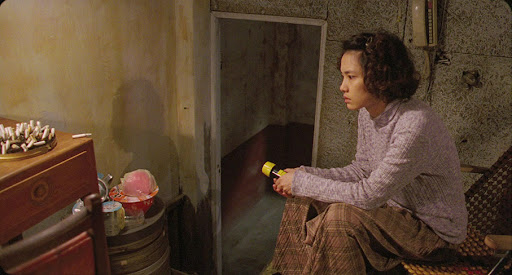
When did it happen for you? When did you first realize just how wrecked your attention span had gotten due to the nature of being alive in the 21st century and processing the world at a speed previously unthought of by humanity?
Were you as pissed off as I was? Wondering what on earth you could do to get it back? Hoping it wouldn’t bore you if you did?
There’s only so much we can do to fight the rising tide of short attention spans. So how do you give your brain a break from it all? Like anyone, I love a good walk, cooking a meal, or cuddling with my pets. But as a cinephile? How do you enjoy that which inadvertently laid the groundwork for the hell we now live in?
You go down the rabbit hole of some slow cinema: that’s what you do.
For some, it’s Andrei Tarkovsky; for others, it’s Lav Diaz; and still for others, it could be Chantal Akerman, Tsai Ming-liang, or Yasujiro Ozu. It’s hard to find a set definition for Slow Cinema, as it isn’t a formal movement like the Taiwanese New Wave or Dogme 95. Slow Cinema is moreso an energy, a je ne sais quoi, a vibe.
“I think that what a person normally goes to cinema for is time”-Andrei Tarkovsky
We’ll be showing Apichatpong Weerasekathul’s slow-cinema classic Tropical Malady on April 3rd at Studio Two Three. It’s not the first quiet or slow movie we’ve shown, but it does belong to what is generally thought of as Slow Cinema: the passing of time is emphasized, it’s minimal in style and narrative, it’s observational, driven by sound (sometimes the lack thereof), and features long camera takes. There’s something about slow cinema that’s not only refreshing but feels like an act of defiance of sorts. You don’t have to watch a movie to turn your brain off-you can in fact watch a movie that makes you acutely aware of the space you’re in, a movie that makes you aware of sights and sounds, a movie that makes you fully exist in a moment. It can feel strange at first, to watch a movie like Taste of Cherry or Goodbye, Dragon Inn, but I’m of the opinion that it’s always worth trying new things, especially in the arts.
There’s a specific, arguably narrow, way of thinking about movies that the average American audience seems to have. It should be 90 minutes to two hours, it should have a three act structure, conversations should happen in a shot/reverse-shot manner, and we should be entertained from start to finish, never aware of the passing of time. Slow cinema spits in the face of this concept, and with good reason. All approaches to cinema are worth considering, and in a world full of constant assault on the senses by advertisers, it’s our god-given right to take our time back, and watch people exist in the silence and the slowness. So if you’re not someone who typically goes for abstract or arthouse movies, try something new! In a space like Studio Two Three, with a large screen and effective sound system, the hypnotic effect of Tropical Malady, a watershed moment in slow cinema, will be something you won’t soon forget.
If you like what you see, check out Chantal Akerman, Lav Diaz, Abbas Kiarostami, Yasujiro Ozu, Andrei Tarkovsky, Hou Hsiao-hsien, Kelly Reichardt, Abbas Kiarostami, Robert Bresson, Bi Gan, and Béla Tarr. This is just scratching the surface.
Mickey 17: A Lukewarm Condemnation – Deirdre Bouquet
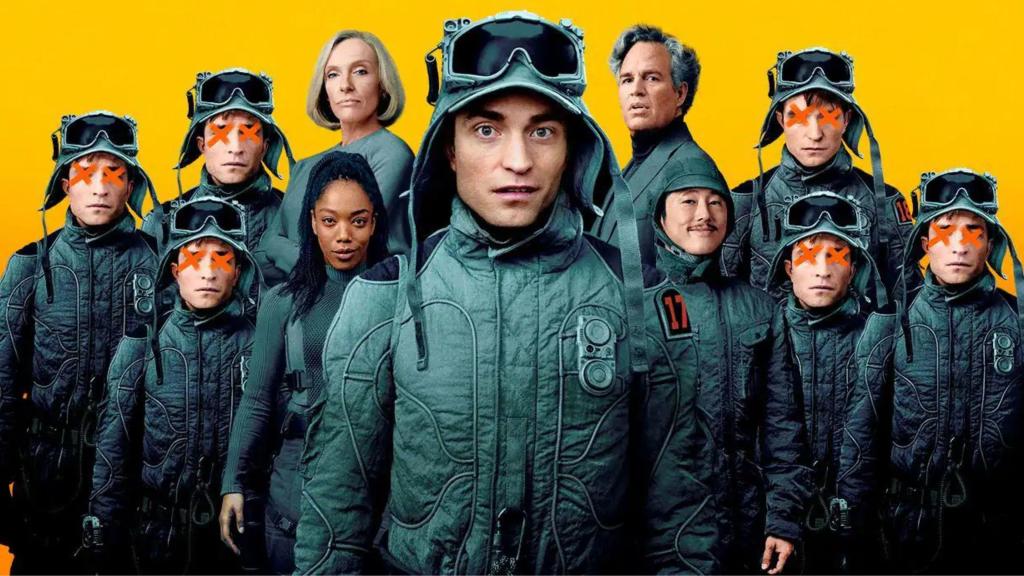
Mickey 17 is a movie I enjoyed well enough when I saw it – it is a sci-fi blockbuster, but a blockbuster that so earnestly wants you to believe it is saying something. This makes it very watchable, without feeling like your brain has entirely shut down. But I find it wastes away in the memory. It is not that it is forgettable, but its glossy coat of political commentary peels away and reveals a rusted out interior.
Mickey 17 has the unique disadvantage of being a Trump satire that seems far better suited for 2016 than 2025, amid a wave of not so much creeping but surging fascism. Mickey 17 is far more concerned with the aesthetic of fascism – embodied in the blithering Kenneth Marshall played by Mark Ruffalo – than the structure of it. Whatever Bong Joon Ho may say, Kenneth is a clear Trump stand-in, with his bizarre tangents, his flair for high drama, and his sheer nouveau riche vulgarity. Kenneth is a transparent buffoon, but he is a buffoon who commands almost the entire ship’s loyalty and admiration. The movie is uninterested both in what conditions in this sci-fi future would set people up to be taken in by this populist leader or how his white supremacist ideology actually plays out among the people he commands. The majority of the ship treats him more like a celebrity than an ideological leader. The movie seems to sacrifice most of its more interesting concerns for this. As an expendable, the titular Mickey is at the bottom of the ship’s social structure. We understand he is exploited, but instead of exploring that exploitation as part of the larger capitalist social structure, it seems far more interested in using it to show how indifferent Marshall and his desired society is to the individual humanity of its subjects. It is not that fascist dehumanization is not worth exploring; rather, an interesting concept is used for some lukewarm exploration of 2018 America rather than what fascism actually means in the context of the science fiction future the film puts forward.
When asked to account for a larger political context of the colony, the movie wants to have things both ways – suggesting that the colony’s institutions both allowed Marshall to come to power but also are a quite effective check on that power. Were these institutions created by Marshall? Were they prescribed by the government of a dying earth consumed by poverty and inequality? More than even the institutions, it was ultimately the colonists’ – who most of the movie were characterized as a braying audience for Marshall – commitment to democratic values that ultimately withstood and overcame Marshall, led by one particular, admittedly badass, woman. It all reads as so painfully naive. Fascism is a rot that infects the whole social system, and it is sustained by more than a single figurehead. This is transparent in 2025 where we see how the current fascist agenda was made possible by 50+ years of right wing infiltration into American institutions, which was in turn made possible by structures of domination embedded in American society that lend themselves to fascist agitprop.
Mickey 17 is overflowing with interesting concepts that it gestures at, many of which feel like they spilled over from Bong’s better films. It hits on colonization, the politics of indigenous sovereignty, white supremacy and eugenics, fascism, and the continuity of the self in the context of the commodification of your body and sense of identity. But ultimately these aren’t themes that the movie actually wants or is capable of grappling with. Many of these elements are simply vestigial set dressing meant to gesture at substance. Worse yet, its reflection on fascism, which the whole movie orbits around, is at best woefully out of pace with the current moment and at worst is actively undermined by the end of the film. Also if you are going to kill off one of your gay characters, maybe don’t literally bury them?
What We’re Into: March 31st Edition
Tommy Jenkins
Tommy is currently into: spring cleaning, walking to work and the grocery store now that the weather is nice, listening to tons of new-to-me music in my new headphones, having more movie nights with friends, and doing my best to make sure 2025 is not another year where I do not read a single book.
Kyle M-B
Kyle is currently into: Playboi Carti – MUSIC
For better and certainly for worst, few artists generate as much hype and intrigue as Playboi Carti. Whether it’s mysterious IG-dropped singles or trying to get a handle on who the man is himself, his realm of influence and mystique has catapulted him to a rap superstardom that is rarely seen. What that means for the music is a level of exploration and confidence that, while not always focused, is sprawling and interesting. At its best, MUSIC is a vibrant and energetic ride through the different eras of Carti’s career with a heavy dose of early 2000s Atlanta rap grandeur.
Fav tracks: RADAR, GOOD CREDIT, TOXIC, LIKE WEEZY
The Day The Earth Blew Up: A Looney Tunes Movie
A 2D fully-animated film from a legacy-property feels like a sentence out of the twilight zone. In a world where films are destroyed for tax purposes or don’t even make it past pre-production, somehow this film was made. Following Daffy Duck and Porky Pig, The Day The Earth Blew Up is a love letter and a continued evolution to one animation and cinema’s longest running properties. It’s filled to the brim with gags and expansive visual humor, is gorgeously rendered, and moves at a brisk pace that will be sure to satisfy any animation enthusiast.
Peter Bogdanovich
Recently one of my cinema fixations has been to listen to Director Peter Bognanovich talk about movies. Bognanovich occupies an interesting place in cinematic history. Born in 1939, he comes at a time where he can have direct access to the directors and artists of old Hollywood while also ushering in a new age of cinematic history with the “New Hollywood” age of the 1970s. One of the last projects he worked on was a podcast titled One Handshake Away in which he would interview directors about older directors he interviewed. Though he died before the podcast was completed, the insights were incredible and showcased a man who not only helped to document cinema’s history, but helped propel it forward.
Sylvie Miller
Sylvie is currently into: Long walks. Enjoying early spring and all its blooms. Leaving my windows open and listening to the birds. Settling into my new-found freedom as I have finally left my place of work. Listening to a lot of Arthur Russell. Watching my favorite Mia Wasikowska comfort films. Getting back into writing poetry. And trying to tackle the stack of books by my bed; currently finishing Connie Converse’s biography.
Lewis Peterson
Lewis is currently into:
–Crossing Delancey dir. Joan Micklin Silver
-the album choke enough by oklou (including the video where she performs on an ice rink !!)
-dutch oven recipes
-anything with radishes
-the soundtrack to Nausicaa of the Valley of the Wind
–Drylongso dir. Cauleen Smith (shoutout Exposure Cinema for showing that)
-blooming springtime flowers
-slow cinema (the likes of Tsai Ming-liang, Apichatpong Weerasethakul, Chantal Akerman, and Abbas Kiarostami)
Syd
Syd is currently into: sunbathing, figuring out what to do with a grocery bag full of rosemary, and sometimes watching shorter, newer, experimental docufiction. Syd also continues to be heavily into Wang Bing.
Warner West
Warner is currently into: The cinema of Lee Chang-Dong (on the Criterion Channel right now) which really knocks my socks off with each entry. Secret Sunshine and Poetry have especially hit hard. Next, new Destroyer album which has been on repeat. Also trying my own marinades for salmon and chicken which don’t always work but make me feel like Remy the rat. Lastly, loose-leaf teas so if you buy locally, hit me up on Instagram or at Tropical Malady on Thursday with recommendations!
Jack Wolfe
Jack is currently into:
- Mel Tormé’s Windmills of Your Mind (and that final frame from the Severance season 2 finale)
- Historic building tours on YouTube
- The Court of Blades activity and master difficulty raid challenges in Destiny 2
- Exploring Gregg Araki’s filmography
- The Eventide Knife Drop effect pedal
- Breathing new life into the Elektron Digitakt
- George Eastman Museum’s “The Art of Projection”
- Playing Alice In Chains guitar riffs
- Reading articles about how generative AI further enables fascism
- Playing Monster Hunter Wilds with my gaming besties
What’s Up Next?
April 3: Tropical Malady at Studio Two Three
April 14: Newsletter w/ preview of our next film (nailing down date but we’ve got the movie picked, and it’s going to be a good one!)
 Hard Light Cinema